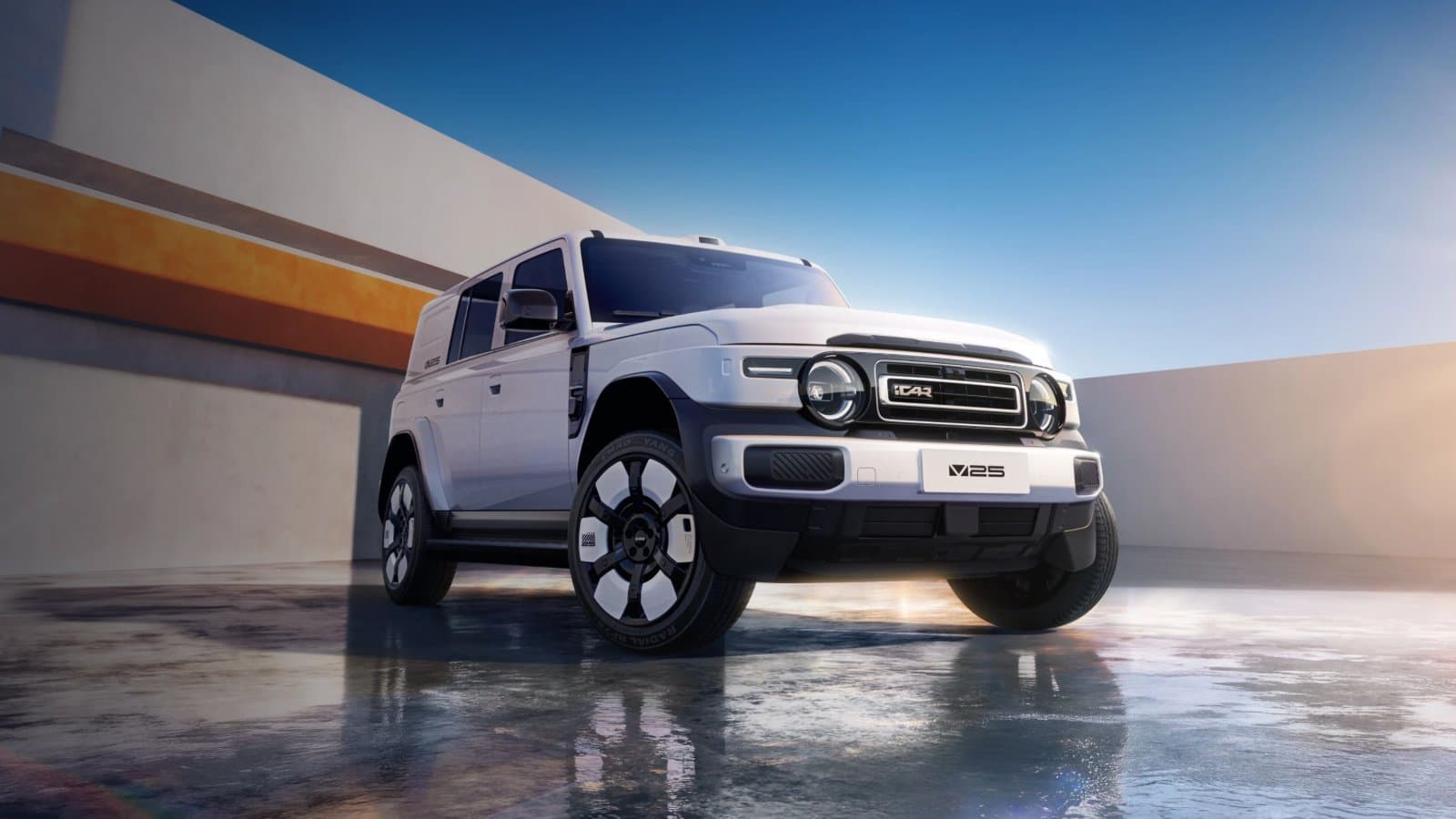
China’s EV market is showing just how fast it is diversifying. On October 19, Chery’s iCar brand opened pre-sales for the new V25 extended-range SUV from 139,800 yuan ($20,800), while fresh trademark details suggested Xiaomi could be preparing a larger, more luxurious sedan under the SU9 Lux name. At the same time, BYD confirmed that its Denza Z9 GT in Europe will receive a major intelligent-driving upgrade in 2027, underscoring how Chinese automakers are no longer competing on price alone, but increasingly on software, luxury positioning, and powertrain breadth.
Chery iCar V25 Opens Pre-Sales at 139,800 Yuan
Chery’s new energy sub-brand iCar is expanding its extended-range SUV lineup with the V25, a mid-size model positioned below the flagship V27. The V25 keeps the brand’s boxy styling theme and broadens iCar’s reach in the fast-growing market for rugged-looking electrified SUVs.
The V25 starts at 139,800 yuan and is offered in four variants, spanning rear-wheel-drive and all-wheel-drive configurations:
| Variant | Drivetrain | Pre-sale Price |
|---|---|---|
| V25 Pro | RWD | 139,800 yuan |
| V25 Max | RWD | 149,800 yuan |
| V25 Max+ | AWD | 163,800 yuan |
| V25 Ultra | AWD | 175,800 yuan |
Pre-sale incentives include:
- 1,000 yuan deposit offsetting 3,000 yuan of the final payment
- 2,000 yuan limited-time credit for selected customization packages
This is iCar’s second extended-range vehicle after the V27, and the timing matters. Extended-range electric vehicles, or EREVs, continue to gain traction in China because they offer EV-style driving with fewer range-anxiety concerns, particularly in lower-tier cities and for buyers who want SUV practicality without relying solely on public charging.
From a product strategy perspective, the V25 looks like a volume play. Its starting price puts it far below premium EREV rivals while still giving Chery room to market higher-spec AWD versions to buyers who want a more lifestyle-oriented package.
Why the iCar V25 Matters in China’s EREV Race
The V25’s significance goes beyond one model launch. It reflects a broader shift in the Chinese EV market, where automakers are increasingly building out multiple sub-segments rather than pursuing a one-size-fits-all strategy.
A few trends stand out:
- Boxy SUV design remains in demand, especially among younger buyers seeking an outdoor-adventure image
- EREV technology is broadening beyond premium brands and moving into more affordable price points
- Chery is using iCar to sharpen its NEV identity in a market dominated by names like BYD, Li Auto, Aito, NIO, and XPeng
For Chery, the V25 could become an important bridge product between mainstream compact EV buyers and customers considering larger electrified SUVs.
Xiaomi SU9 Lux Hints at a New Executive Sedan
While Chery is pushing into accessible electrified SUVs, Xiaomi appears to be exploring the opposite end of the market: a larger, more luxurious sedan.
According to trademark details surfaced in China, Xiaomi applied for the “XIAOMI SU9 LUX” trademark on February 13, 2026 under Class 12, covering automobiles. The application was published for preliminary approval on June 6, with an opposition period running from June 7 to September 6.
The name has been linked by several Chinese bloggers to a camouflaged long-wheelbase sedan previously referred to informally as the SU7L. Spy photos suggest a car that is noticeably longer than the standard SU7, with estimated dimensions of:
- Length: more than 5.2 meters
- Wheelbase: about 3.1 meters
Those numbers would place the car firmly in executive-sedan territory, where rear-seat comfort becomes just as important as straight-line performance.
Xiaomi’s Upmarket Play Is Starting to Take Shape
Xiaomi’s automotive business has moved quickly since the original SU7 launched in March 2024. The company followed with the SU7 Ultra in February 2025 and unveiled a new-generation SU7 in March 2026. A potential SU9 Lux would add a different flavor to the lineup.
Rather than chasing only performance enthusiasts, Xiaomi could be targeting buyers who want:
- More rear legroom
- A chauffeur-friendly executive layout
- A higher-end luxury image
- A sedan positioned above the regular SU7 in comfort and status
That would be a logical expansion. In China, the premium sedan market has room for brands that can combine software appeal, strong in-car tech ecosystems, and competitive pricing. Xiaomi’s consumer-electronics DNA may give it an edge with buyers who value smart-cabin integration as much as driving dynamics.
Still, it is important to separate evidence from speculation. At this stage:
- The SU9 Lux name is not officially confirmed for production use
- The vehicle’s final specifications remain unannounced
- Xiaomi has not publicly detailed its market positioning
Even so, the trademark and test-car sightings strongly suggest Xiaomi is studying a more luxurious, space-focused sedan category.
BYD Denza Z9 GT Gets a Software-Led Upgrade for Europe
If Chery and Xiaomi show how Chinese brands are expanding at home, BYD demonstrates how they are evolving abroad.
BYD has confirmed that the Denza Z9 GT in Europe will receive an OTA update in 2027 that adds its God’s Eye intelligent driving system with City Navigation on Driving Assistant (CNOA) capability. The move is notable because it shows BYD using software upgrades to improve vehicles already on sale, an approach that has become central to competition in the EV industry.
According to BYD, the update will rely on hardware already fitted to the vehicle, including:
- 1 LiDAR
- 12 ultrasonic radar sensors
- 3 millimeter-wave radar sensors
- 11 cameras
Once activated, the system is designed to handle more advanced urban-driving tasks such as:
- Stopping at red lights
- Yielding at roundabouts
- Following posted speed limits
- Making left turns
- Changing lanes around double-parked vehicles
- Detecting pedestrians and cyclists on narrow city streets
This matters because urban ADAS performance is becoming a major differentiator, particularly in Europe where buyers are increasingly familiar with advanced driver-assistance features but still face a fragmented regulatory and infrastructure environment.
Denza Z9 GT: Luxury EV Hardware to Match the Software Story
The Denza Z9 GT is also impressive on paper. In Europe, it is available as both a battery electric vehicle (BEV) and a plug-in hybrid (PHEV), giving BYD more flexibility across different customer needs.
For the all-electric version, BYD quotes:
| Specification | Denza Z9 GT EV |
|---|---|
| Battery | 122.49 kWh |
| Motors | 3 |
| Power | 1,140 hp (850 kW) |
| Torque | 1,210 Nm |
| WLTP Range | Up to 599 km |
BYD has also used the model to showcase its latest charging technology. The company says its Flash Charging system can deliver up to 1,500 kW, reinforcing its argument that charging speed is becoming a core premium feature in addition to range and performance.
Electrek also noted that Denza previously claimed a CLTC range of up to 1,036 km for the Z9 GT in China, though that figure comes from China’s more generous test cycle and should not be directly compared with the European WLTP 599 km rating.
Comparison: Three Very Different Chinese EV Strategies
Taken together, these developments show how broad the Chinese EV playbook has become.
| Brand | Model/Project | Segment | Key Focus | Market Signal |
|---|---|---|---|---|
| Chery iCar | V25 | Mid-size EREV SUV | Affordable electrified lifestyle SUV | Expansion into volume EREV market |
| Xiaomi Auto | SU9 Lux (rumored) | Executive sedan | Rear-seat comfort, luxury positioning | Upmarket sedan diversification |
| BYD Denza | Z9 GT | Luxury GT / flagship | Software-defined driving, fast charging, premium hardware | European premium expansion |
The common thread is that all three are moving beyond the basic “cheap Chinese EV” narrative.
Why This Matters Globally
These announcements highlight three of the most important shifts in the global EV market:
1. Chinese brands are attacking every segment
They are no longer focused only on entry-level EVs. The market now spans affordable EREVs, luxury GTs, performance sedans, and executive long-wheelbase cars.
2. Software is becoming as important as hardware
BYD’s 2027 OTA plan for Denza shows that premium competition increasingly depends on intelligent driving and upgradeable vehicle platforms, not just battery size or motor output.
3. Powertrain diversity remains a competitive weapon
While Western markets often frame the future as BEV-only, Chinese automakers continue to use BEV, PHEV, and EREV formats strategically. That flexibility is helping brands meet different consumer expectations across China and export markets.
The Bigger Industry Picture
Chery, Xiaomi, and BYD are taking different routes, but they are reacting to the same reality: China’s EV market is maturing fast.
That maturity is creating several new battlegrounds:
- Price-to-feature value in mainstream SUVs
- Brand elevation in executive and luxury segments
- ADAS capability as a premium selling point
- Charging speed and energy flexibility as daily usability differentiators
For legacy global automakers, this is the real warning sign. Chinese brands are no longer winning only through lower costs. They are building coherent product ladders, creating stronger sub-brands, and using software to extend value after delivery.
What to Watch Next
In the near term, several questions will determine how meaningful these moves become:
- Can the iCar V25 convert pre-sale attention into strong delivery volumes?
- Will Xiaomi formally confirm the SU9 Lux and define it as a true flagship sedan?
- Can BYD’s God’s Eye rollout in Europe strengthen Denza’s credibility against German premium rivals?
What is already clear is that Chinese EV makers are entering a new phase. The next battle will not be just about electrification itself, but about who can best combine range, software, luxury, and brand identity across multiple markets.


