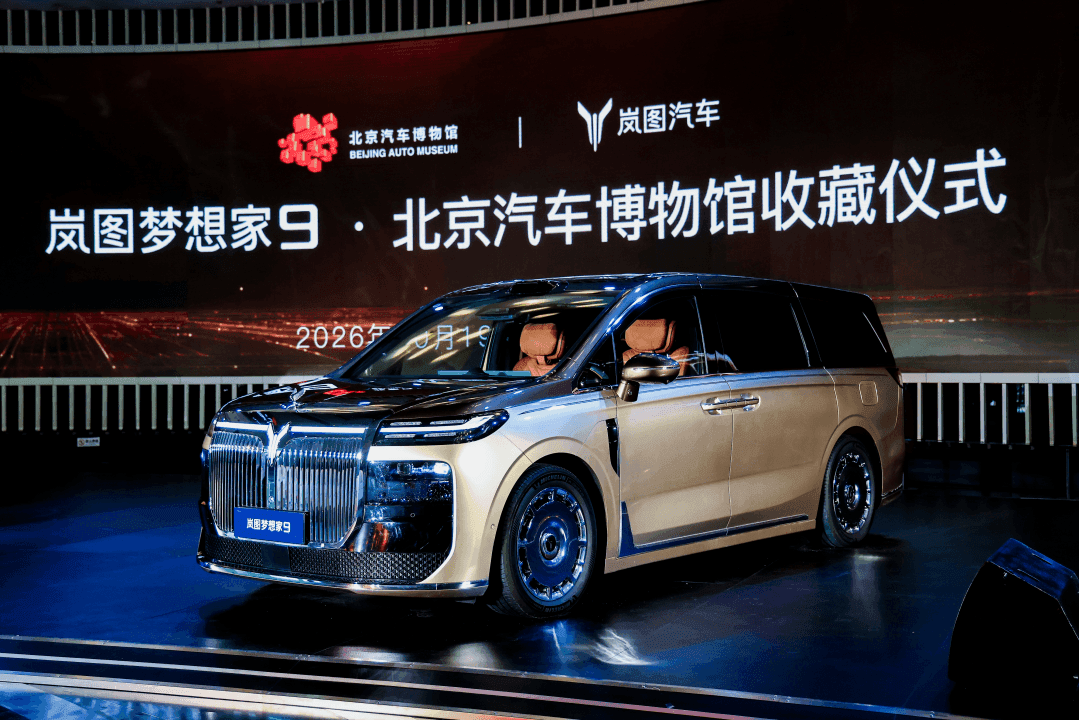
China’s EV industry delivered three very different but closely connected signals this week: VOYAH’s Dreamer 9 became the first high-end MPV collected by Beijing Auto Museum, FAW-Volkswagen said its new ID. AURA T6 secured 33,022 locked orders in its first sales month, and Gotion High-Tech unveiled a next-generation CTB battery-integrated heavy-truck pack that cuts vehicle weight by about 400 kg. Together, these developments show how the Chinese EV market is no longer defined only by price wars or volume growth, but increasingly by design identity, localized smart technology, and deeper battery-system integration across both passenger and commercial vehicles.
VOYAH Dreamer 9 Enters Beijing Auto Museum
On October 19 in Beijing, VOYAH held a design-themed event alongside a collection ceremony at the Beijing Auto Museum, where the Dreamer 9 was formally added to the museum’s collection. According to the source, this makes it the first high-end MPV to be collected by a national first-class automotive museum in China.
That matters for more than branding. Museum collection status is symbolic recognition that a vehicle represents a milestone in industrial development, design language, and technological progress. In this case, the Dreamer 9 is being positioned as a marker of how Chinese automakers are moving from product followers to creators of their own premium automotive culture.
Why the Dreamer 9 stands out
VOYAH says the Dreamer 9 is the world’s first MPV with a rising hood ornament, and its broader design theme leans heavily into original Chinese aesthetics rather than established European luxury-MPV formulas.
Key design elements highlighted by the brand include:
- An original “Eastern aesthetics” design direction
- The Kunpeng Lingyun upright emblem
- Headlamp styling inspired by celestial imagery
- Decorative motifs drawing on dragon-scale patterns
- A design philosophy tied to “heaven, earth, and stars” imagery
More importantly, VOYAH’s designers argue that Chinese cultural references are no longer being applied as surface decoration. Instead, they are becoming part of the vehicle’s:
- Body proportions
- Spatial layout
- Functional logic
- Interior interaction details
That distinction is important in today’s Chinese EV market, where premium brands increasingly need more than strong specifications. They also need a recognizable design identity.
Beyond Symbolism: Dreamer’s Market Proof
VOYAH’s museum moment would carry less weight if the product itself lacked market traction. But the company claims the Dreamer family has already built scale in China’s new-energy MPV segment.
According to the source, the Dreamer lineup has:
- Attracted more than 200,000 users
- Built a product range covering the RMB 300,000 to RMB 700,000 segment
- Earned a “triple crown” reputation in sales, user word of mouth, and quality
The report also points to a headline-grabbing structural test: the Dreamer 9 reportedly completed a moving whole-vehicle load challenge under a 10.8-meter stacked tower and 18.1-ton load, then drove 35 meters while maintaining door functionality and showing no body deformation.
Even allowing for the promotional nature of automaker-led tests, the messaging is clear: Chinese premium EV brands are increasingly pairing cultural storytelling with hard engineering validation, especially around safety.
FAW-Volkswagen ID. AURA T6 Posts 33,022 First-Month Orders
If VOYAH represents Chinese premium branding, FAW-Volkswagen’s ID. AURA T6 reflects another major trend: global legacy automakers localizing aggressively for China’s electric and intelligent-vehicle market.
FAW-Volkswagen announced that the ID. AURA T6 recorded 33,022 locked orders in its first sales month after launching on September 20. The model is priced at RMB 129,900 to RMB 166,900, a notably aggressive range for a midsize pure-electric SUV with advanced driver-assistance hardware.
The company also disclosed two striking data points:
- More than 90% of orders were for the LiDAR version
- Nearly 80% of buyers were first-time Volkswagen customers
That suggests the T6 is not just retaining existing VW users. It appears to be attracting fresh Chinese EV buyers who may previously have looked to domestic brands for software-defined features.
Why the ID. AURA T6 looks different from older VW EVs
Volkswagen’s earlier ID models in China were often criticized for lagging local competitors in software experience, cabin intelligence, and some chassis details. The ID. AURA T6 appears designed specifically to answer those complaints.
Key specifications and features
| Item | FAW-Volkswagen ID. AURA T6 |
|---|---|
| Launch date | September 20 |
| Price range | RMB 129,900-166,900 |
| Orders in first month | 33,022 |
| Body style | Midsize pure-electric SUV |
| Dimensions (L/W/H) | 4,811/1,879/1,648 mm |
| Wheelbase | 2,836 mm |
| Motor output | 170 kW single motor |
| Battery chemistry | LFP |
| CLTC range | 550 km / 620 km |
| Fast charging | 800V platform, 10 min for 300 km |
| Smart driving | Highway NOA + urban navigation assist |
| Compute platform | Horizon Journey 6H, 420 TOPS |
| LiDAR | Optional 192-line roof LiDAR |
Localized upgrades that matter
The T6’s package is notable not because any one item is unique, but because Volkswagen appears to have assembled a very China-specific feature set:
- New CEA electronic/electrical architecture
- 10.25-inch instrument display
- 15.6-inch center screen
- 25.8-inch AR-HUD
- 4nm cockpit chip with about 20 TOPS of computing power
- Wireless CarPlay, HiCar, and Carlink
- A 90L front trunk
- Chinese-developed smart-driving system from the VW-Horizon joint venture
This is a significant shift in strategy. Rather than adapting a global EV package for China, Volkswagen is increasingly using local hardware, local software stacks, and local ADAS optimization for Chinese road conditions.
Braking, Safety, and the End of an Old VW Weakness
One of the most practical upgrades on the ID. AURA T6 is also one of the least glamorous: braking hardware.
Earlier Volkswagen ID models in China drew criticism for rear drum brakes. On the new T6, FAW-Volkswagen says all versions get four-wheel disc brakes plus Bosch IPB 2.0. For many Chinese EV shoppers, especially those comparing spec sheets closely, this addresses a long-running perception gap.
The company also highlights:
- Steel-aluminum mixed cage body structure
- More than 80% ultra-high-strength steel
- 2,000 MPa hot-formed steel in key areas
- Claimed C-NCAP five-star and C-IASI all-good safety ratings
- Front stabilizer bar and 255/265 mm tires for added stability
In other words, Volkswagen is trying to show that it can still compete on fundamentals like chassis tuning and passive safety while catching up in software-defined areas.
Gotion High-Tech Pushes CTB Into Electric Heavy Trucks
The passenger-EV market gets most of the attention, but China’s commercial EV sector may be just as strategically important. This is where battery-system integration can generate immediate operational value.
Gotion High-Tech has now introduced a new-generation CTB (Cell to Bracket) rear-back integrated battery solution for heavy trucks. The concept is straightforward: eliminate redundant pack structures and integrate the battery system more directly into the vehicle architecture.
That reduces wasted volume and mass, both of which matter enormously for trucks.
Key gains claimed by Gotion
| Metric | Gotion CTB Heavy-Truck Battery |
|---|---|
| Battery capacity range | 400-700 kWh |
| Vehicle weight reduction | About 400 kg |
| System height | 943 mm |
| Height reduction | 40% |
| Volumetric energy density | 250 Wh/L |
| Vehicle-level energy density | Over 160 Wh/kg |
| Validation | 6,000 km vehicle durability test |
For heavy trucks, a 400 kg reduction is a serious number because every kilogram saved can be translated into payload, efficiency, or route flexibility.
Why CTB matters in trucking
Compared with conventional “single-pack” battery designs, CTB architecture can improve:
- Packaging efficiency
- Vehicle center of gravity
- Payload potential
- Thermal-system layout
- Maintenance access, depending on design execution
Gotion says the new product uses a water-electric separation design, with cooling pipes mounted externally. That is intended to reduce the risk of coolant leakage affecting cells while also making service work easier.
For cold-weather operations, the system supports:
- Liquid cooling
- Liquid heating
- Optional PTC ceramic heating
This is particularly relevant for Chinese freight operators working in northern regions, where winter charging and discharge performance can sharply affect uptime.
Comparing the Three Developments
Although these stories span a premium MPV, a mass-market electric SUV, and a heavy-truck battery system, they point to the same broader direction for the Chinese EV industry.
| Development | Main takeaway | Why it matters |
|---|---|---|
| VOYAH Dreamer 9 enters museum collection | Chinese brands are building cultural and design legitimacy | Premium EV competition now includes identity, not just specs |
| VW ID. AURA T6 gets 33,022 orders | Global automakers must localize deeply to compete in China | LiDAR, smart driving, and software are now mainstream purchase drivers |
| Gotion CTB truck battery cuts 400 kg | Battery integration is moving into commercial vehicles at scale | EV innovation is spreading beyond passenger cars into logistics and freight |
Why This Matters Globally
For international readers, the biggest takeaway is that China’s EV industry is evolving on several levels at once.
First, design confidence is growing. Brands like VOYAH are no longer presenting themselves as lower-cost alternatives; they are trying to define what Chinese premium automotive design looks like.
Second, local software ecosystems are becoming decisive. Volkswagen’s strong early order result suggests that even established global brands cannot rely on badge strength alone in China. They need Chinese ADAS partners, Chinese cockpit stacks, and products tuned for local usage patterns.
Third, battery integration is extending into commercial transport, where total cost of ownership matters more than marketing. If CTB and related architectures prove durable at scale, they could accelerate electric heavy-truck adoption in logistics, ports, and regional freight.
There is also a supply-chain angle. China’s advantage increasingly lies not just in cell manufacturing, but in complete systems integration across:
- Battery design
- E/E architecture
- Smart-driving compute platforms
- Vehicle software
- Manufacturing scale
The Competitive Landscape Ahead
The next phase of competition in Chinese EVs will likely be shaped by three filters:
-
Can brands create a clear identity?
This is where VOYAH’s museum recognition matters. Premium branding in China is becoming more culturally self-defined. -
Can automakers localize fast enough?
Volkswagen’s T6 shows that the answer may be yes—but only with deep local partnerships and aggressive product resets. -
Can suppliers turn engineering gains into fleet economics?
Gotion’s CTB heavy-truck system will be judged by payload benefit, uptime, thermal reliability, and serviceability in real-world operations.
What to Watch Next
Several questions now follow from these announcements:
- Can VOYAH convert symbolic recognition into stronger premium-market share?
- Will the ID. AURA T6 sustain its first-month momentum once deliveries ramp and user feedback emerges?
- Can Gotion’s CTB heavy-truck solution win major fleet customers and expand beyond pilot-scale deployment?
What is already clear is that the Chinese EV market is maturing into something broader than a simple volume race. It is becoming a contest over design language, intelligent driving usability, and structural efficiency across the entire vehicle stack—from museum-worthy flagship MPVs to LiDAR-equipped family SUVs and battery-integrated electric trucks.


