D1EV reported that Baidu Apollo has disclosed Apollo World, a full-modality world model driven by AI agents, at its Shenzhen AI Day Apollo event. Baidu positioned the system as a simulation platform for L4 autonomous driving that can run complete trips in a virtual environment and respond to vehicle actions in real time.
Baidu also set out what it called a “2+3” standard for world models. The two baseline requirements are causality and interactivity. The three higher-level performance measures are physical accuracy, persistence and real-time capability.
Baidu’s framing is that a world model for autonomous driving must do more than generate realistic video or build a virtual space for people to explore. It must support safety validation for autonomous vehicles in a simulation that can take a vehicle from departure to destination while remaining consistent with physical rules and interaction feedback.
Why Baidu says older simulation tools are insufficient
Baidu said replay-based simulation, which re-runs recorded road scenes and sensor data, has helped early autonomous driving development but has important limits. In replay tests, pedestrians and other vehicles follow the original recorded trajectories and do not react when the tested vehicle behaves differently.
That creates a problem when a vehicle model is updated. If the new model changes lanes one second earlier than before, surrounding vehicles in a replay system still follow the old paths, making the test scene inconsistent with how real traffic would respond.
Baidu said this means the simulated world becomes unreliable as soon as the tested vehicle’s behavior diverges from the original recording. It also means replay cannot properly test dynamic interactions such as braking, yielding or merging, where surrounding road users would normally respond.
Real-world road testing has its own constraints. Baidu world model head Yang Ze said each model iteration goes through more than 700,000 km of real road testing before being used with passengers, and that only after 700,000 km with human safety operators and no dangerous road situations is a version put into service.
Baidu said that process becomes hard to scale when entering a new city or expanding into a new area, because similar validation needs to be repeated. It also said long-tail and high-risk scenarios such as sudden intrusions by vehicles, cyclists or other obstacles are difficult to reproduce on demand in real traffic and cannot be repeatedly tested on public roads without risk.
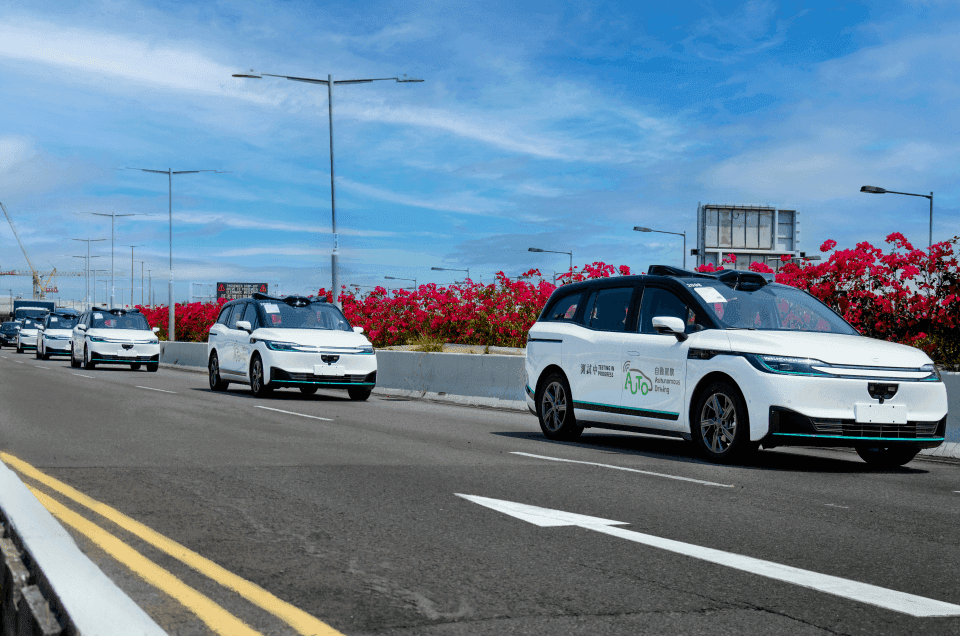
Baidu said Apollo Go has now landed in 28 cities globally, completed more than 23 million ride services and accumulated more than 350 million km of autonomous driving mileage, including more than 240 million km in fully driverless operation.
Baidu’s “2+3” standard
Baidu said causality is required because a world model must reflect the sequence of cause and effect in the real world. A model that can effectively see later outcomes and then alter earlier frames would break real-world causal rules and would not be useful for driving validation.
The second threshold is interactivity, meaning the vehicle’s actions must change the virtual world. Baidu gave an example of a white car preparing to merge from a side road. If the ego vehicle takes an elevated road and leaves space, the white car merges. If the ego vehicle stays on the surface road and blocks the merge space, the white car waits.
For physical accuracy, Baidu said the system must reproduce how sensors and objects behave under real conditions. It cited examples including longer braking distances on wet roads, lidar rays being absorbed by rain, splash being captured by lidar, and snow scenes where the ground has snow cover and trees should not appear green.
For persistence, Baidu said the world model must avoid drift over long trips, which in Robotaxi operations can last from five minutes to two hours. Its approach uses a long-attention mechanism so each generated frame can refer back to all information since the start of the trip, rather than only recent frames.
For real-time performance, Baidu said the system must keep pace with the vehicle model’s decision cycle. Each frame in Apollo World involves data from 10 cameras producing 9 million RGB pixels and four lidars producing about 300,000 points, with the model processing 24 frames per second.
Baidu contrasted that with Google DeepMind’s Genie 3, which it said reached 24 frames per second at 720p resolution in August 2025 and maintained consistency for several minutes. Baidu said the comparison is limited because Apollo World generates full sensor data for vehicle models rather than images for human viewing.
How Apollo World works
Baidu said Apollo World has three key technical elements: multi-agent simulation, multimodal sensor generation and trip-level closed-loop interaction.
In the system, each obstacle is modeled as an AI agent with perception, decision-making and interaction abilities, rather than as a scripted object following a fixed path. These agents have their own destinations and behavioral logic and can adjust in real time to surrounding changes.
Apollo World also generates data across multiple sensor modalities, including camera images and lidar point clouds, and Baidu said the outputs must stay aligned so that the same object appears in the corresponding position across modalities.
The closed-loop process starts with the world model generating observations for the vehicle’s end-to-end driving model. That driving model outputs control signals such as steering and braking, which are fed back into the world model. The world model then updates the environment and generates the next frame.
Baidu said this differs from video generation, where a full sequence is generated at once and cannot respond step by step to actions.
Demonstrations in Shenzhen and Hong Kong
Baidu said trip-level simulations can already run end to end in Apollo World. In Shenzhen, it demonstrated a virtual order traveling from Binhai Avenue to A8 Tower, with camera views, radar point clouds and agent interactions generated by the world model rather than by pre-recorded city footage.
In Hong Kong, Baidu said a virtual order starting from the same point could be routed to four different destinations, diverging at intersections and evolving differently afterward. It also said traffic density can be adjusted across low, medium and high settings to simulate rush hours and nighttime conditions.
Baidu said risky scenarios can also be reproduced on demand, including a vehicle suddenly emerging into view, a cyclist entering unexpectedly, or a dog running onto the road. It said the same starting conditions can be used to generate multiple parallel outcomes for repeated testing.
Baidu said the system is built on more than a decade of autonomous driving research and several years of real-world operations data. It said high-value scenarios from real operations are extracted for world-model simulations, and virtual test results are then used to improve the vehicle-side model.
The report noted that Baidu did not quantify how much real-world testing Apollo World can replace, how much city deployment validation time could be shortened, or how much labor and safety-operator cost could be reduced.