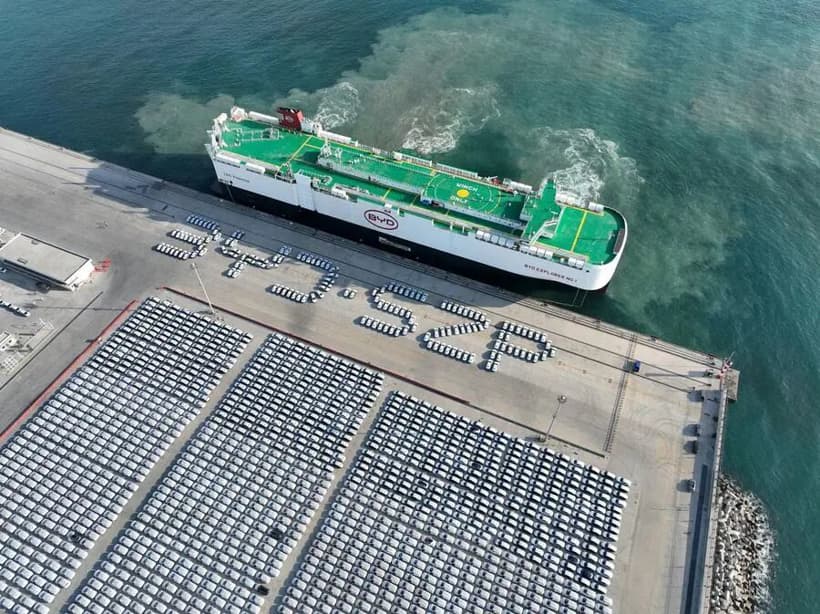
Gasgoo reported that China will cut the value-added tax export rebate for new energy vehicles to 9% from 13% starting on April 1, 2027. The change covers 67 product categories including battery electric passenger vehicles, plug-in hybrid passenger vehicles including range-extended models, and electric commercial vehicles, while fuel vehicle export rebates will remain at 13%.
The policy was announced on October 12 by the Ministry of Finance and the State Taxation Administration. It came three days after China and the EU reached an understanding in Beijing on hybrid vehicle trade, and 39 days after three ministries issued guidance on overseas competition and compliance in the auto industry that warned carmakers against low-price fighting abroad.
The move extends a broader rollback in China's export rebate policy. In December 2024, export rebates for aluminum and copper products were canceled, while rebates for photovoltaics and batteries were cut from 13% to 9%. From April 2026, photovoltaic export rebates were cut to zero, battery rebates were lowered to 6%, and battery rebates are set to fall to zero in January 2027.
In 2025, China's export tax rebates exceeded RMB 2 trillion for the first time, reaching RMB 2.13 trillion, equal to 12.1% of that year's tax revenue and the highest level since 2008. General public budget revenue fell 1.7% year on year in the same year.
In the first three quarters of 2026, China exported 4.006 million new energy vehicles, accounting for 48.8% of total vehicle exports and up 1.3 times year on year.
Impact on automakers
Deutsche Bank estimated that the rebate cut will reduce BYD's net profit per exported vehicle by about RMB 5,000. A JPMorgan sensitivity test showed that if automakers do not raise prices at all, the potential decline in 2027 earnings would be about 18% for BYD and Leapmotor, about 10% for Geely, and about 6% to 8% for Great Wall Motor and Chery.
Industry estimates generally put the hit to gross margin on exported models at less than 2 percentage points.
Among major listed carmakers, overseas revenue accounted for 52.4% at Chery, 41.1% at Great Wall Motor, 38.7% at BYD, 23.2% at SAIC Motor, 21.4% at Geely, 20.2% at Changan, and 17.6% at GAC in 2025.
Overseas gross margins differed as well: Geely was at 26%, BYD at 19.5%, Changan at 19.5%, Great Wall Motor at 16.7%, and SAIC at 12.9%. SAIC's vehicle business gross margin was 4.3%.
Because the cut applies only to new energy vehicles, the effect is lighter for companies whose exports are still led by fuel vehicles. That gives companies such as Chery and Great Wall Motor more room, while BYD, whose exported models are all new energy vehicles, faces the direct effect.
Wanlian Securities judged that smaller carmakers and export trading businesses without scale and overseas systems may be cleared out faster. CITIC Securities expected automakers to share the impact through adjustments to retail prices and dealer rebates. Bernstein said intense competition will make obvious price increases difficult, so the short-term effect will mainly be margin compression rather than higher overseas selling prices.
Export timing and localization
The rebate cut applies only to vehicles exported through Chinese customs. Vehicles produced at BYD's Hungary plant will not be affected.
The transition rule is based on the customs declaration date, which is likely to trigger a rush in exports before April 1, 2027. As a result, first-quarter 2027 export data may appear artificially high.
The lower rebate also reduces one point of political pressure in Europe. The European Commission included export tax rebates in the list of suspected subsidies when it opened its anti-subsidy investigation in 2023. Cutting the rebate to 9% will not remove European trade barriers, but it may weaken arguments that low-price Chinese exports are being financed by fiscal support.
CITIC Securities Hong Kong forecast that the export rebate rate for new energy passenger vehicles may gradually fall to zero by the end of 2028.


