D1EV reported that Chery has put its first large-scale vehicle-to-grid, or V2G, operating site into service in Wuhu and set a goal of building more than 20,000 V2G-standard charging stations globally by 2029. The report said the site was launched by Chery Green Energy and State Grid Anhui Electric Power Mingsheng Group in Wuhu four days before the opening of the 2026 Chery Global Innovation Conference on October 20.
According to D1EV, Chery presented V2G as a business model that lets EV owners charge during off-peak hours and sell electricity back to the grid during peak hours. The company said parked vehicles can become mobile energy storage assets that are tradable and income-generating through two-way interaction with the grid.
D1EV said Chery used the Fulwin A9 as an example of possible user income. With a 70-kWh battery, daily discharge of 40 kWh, and participation on 200 days a year, the theoretical income from peak-valley price differences would be about RMB 5,600. After site service fees and handling fees, users are expected to receive more than RMB 3,000, and income could be higher if local V2G discharge subsidies are added.
The report said Chery has launched both single-household and large-scale aggregated grid connection, with charging and discharging managed through an app and cloud scheduling. Travel time, target battery level and real-time electricity prices are included in the system's calculations so daily vehicle use is not affected, while earnings can be credited automatically.
D1EV cited State Grid estimates saying that if 10% of new energy vehicles take part in vehicle-grid interaction by 2030, they could provide a maximum of 86 million kW of regulating capacity.
Charging network plan
According to D1EV, Chery's first V2G large-scale operating site is already in operation in Wuhu. The company plans to add "flash charging + V2G" sites in Shanghai, Guangzhou, Hefei and Wuhu, and to debut V2G capability in the battery electric version of the Fulwin A9 in the first half of 2027.
Chery has also set a target of building more than 20,000 V2G-standard charging stations globally by 2029, D1EV said.
The report outlined other parts of Chery's charging ecosystem that it said support wider V2G deployment. Its Xunlong flash charging system has terminal power of 1,440 kW and can add 500 km of range in 5 minutes, according to D1EV. The company said the system uses oil-sealed immersion cooling to improve heat dissipation efficiency by 30%.
D1EV also said Chery's automatic charging robot has repeat positioning accuracy of 0.1 mm and can complete plug insertion within 30 seconds, while being compatible with 99% of vehicles and DC chargers.
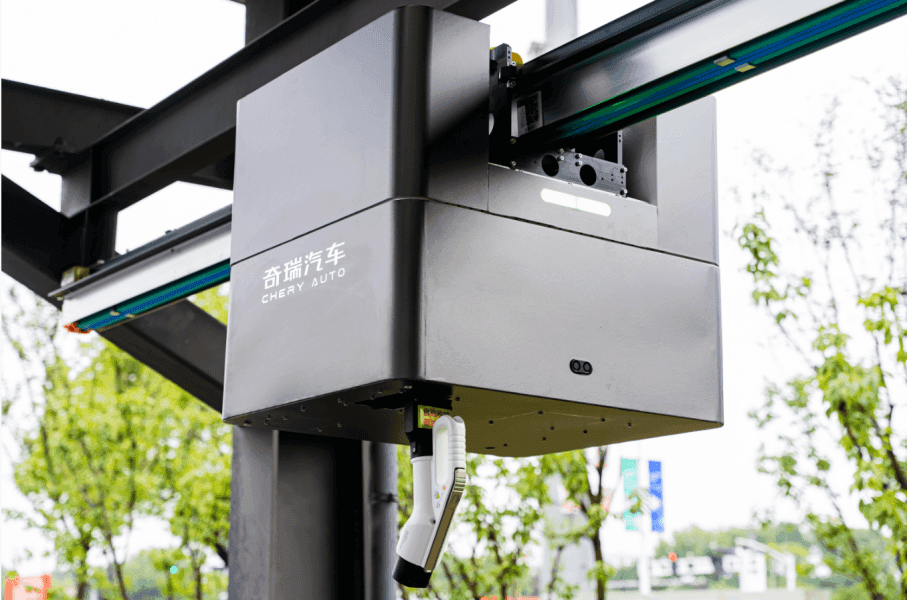
For rail-based charging, D1EV said a combination of overhead guide rail and robot can extend the coverage of a single 200-kW charging unit to 16 to 80 parking spaces. The report said this setup occupies no parking spaces and can be brought online in 3 days, about 10 days faster than traditional solutions.
Technology and battery details
D1EV said Chery's AC V2G system under China's national standard reuses the vehicle's onboard charger, avoiding the need for households to add extra high-power external equipment. For DC V2G, the company uses high-voltage silicon carbide devices and said system efficiency reaches 96.5%.
Under the European standard system, D1EV said Chery uses a DC format rated at 7 kW or 11 kW. The company said black-start capability enables grid-connected and off-grid switching in 10 milliseconds, and anti-backflow design reduces grid-side risk while allowing emergency power supply for the whole household during outages.
D1EV said Chery's production AC V2G solution uses Bluetooth communication between vehicle and charger, reusing the vehicle's existing Bluetooth module to create a point-to-point connection and keeping access costs close to zero.
On the power equipment side, D1EV said Chery's DC V2G setup uses high-voltage silicon carbide power devices, achieves 96.5% system efficiency, and controls total harmonic distortion within 3%, better than the 5% limit in the national standard.
The report added that Chery's energy cloud platform aggregates V2G vehicles, bidirectional chargers, energy storage and solar power through a virtual power plant. It also said the company introduced a precise scheduling solution for a cluster of 1 million chargers.
Battery durability and safety are central to owner acceptance of V2G, D1EV said. The report said Chery's virtual power plant platform and battery management system keep charging and discharging within a 20% to 80% range, reducing power or stopping operation if temperature, state of charge or battery health becomes abnormal.
D1EV said Chery's Rhino battery retains more than 80% of its capacity after 5,000 charge-discharge cycles. It also passed tests including 200 kN compression, 105 seconds of fire exposure, a 5-meter drop and 48 hours of water immersion.
According to D1EV, private cars typically charge 50 to 100 times a year, while power batteries generally have cycle life of 2,000 to 3,000 times. Based on a 10-year usage cycle, the report said the Rhino battery's 5,000-cycle life leaves substantial margin for participation in vehicle-grid interaction.


